SSL Monitoring API for Production Teams
Detect expiring certificates, invalid trust chains, and HTTPS issues before customers notice. Pull SSL and uptime data into your own automation with predictable, developer-first JSON.
Built for practical workflows in DevOps, platform, and engineering teams.
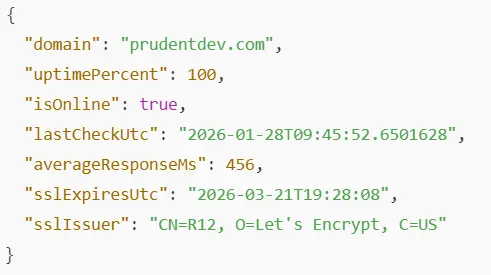
Why teams use this API
- Automate certificate checks in scripts and incident workflows
- Pull SSL and uptime context into status reporting
- Track trust and expiration trends for critical endpoints
- Keep reliability and security telemetry in one integration path
What you can monitor
Certificate expiration windows
Monitor days remaining and trigger proactive renewal workflows.
TLS trust and validity
Surface invalid chains, trust failures, and protocol-level certificate problems.
HTTPS endpoint behavior
Combine handshake results with response-time and uptime context.
Authenticated endpoint checks
Monitor protected routes by attaching allowed request headers with encrypted storage.
How teams automate with it
Incident triage
Pull SSL and uptime history to quickly answer whether an outage is certificate-related.
Weekly reliability reporting
Export endpoint health trends into client reports and internal operations summaries.
Renewal runbooks
Trigger staged reminders as certificates approach expiration thresholds.
Operational integrations
Feed structured certificate status into dashboards, reporting, internal tooling, and custom workflows.
FAQ
An SSL monitoring API lets you programmatically track certificate validity, expiration timing, and HTTPS health for endpoints.
Yes. Combining SSL checks with uptime checks reduces blind spots and simplifies incident response.
Yes. Internal service failures can be just as disruptive, especially when upstream dependencies fail silently.
Related pages
Use SSL data like an engineering team
Build reliable certificate workflows with clean API output and practical alerting.
Try SiteInformant